Antan IRM - Intelligent Risk Management
An AI-powered cyber risk platform I built and use for my own quantitative risk and decision analysis. It began as a replacement for the spreadsheet risk register and grew into a tool that turns scattered security data into quantified, board-ready decisions across your register, third-party and product risk, and compliance. Risk in money and probability, not gut-feel ratings.
A tool I built and use in my own engagements, not a supported product, and very much a work in progress: it already does real work, and it keeps getting better. There is no trial to sign up for; try the demo, and if you would like to know more about Antan IRM, get in touch. Feedback is welcome, and who knows, it may go public one day.
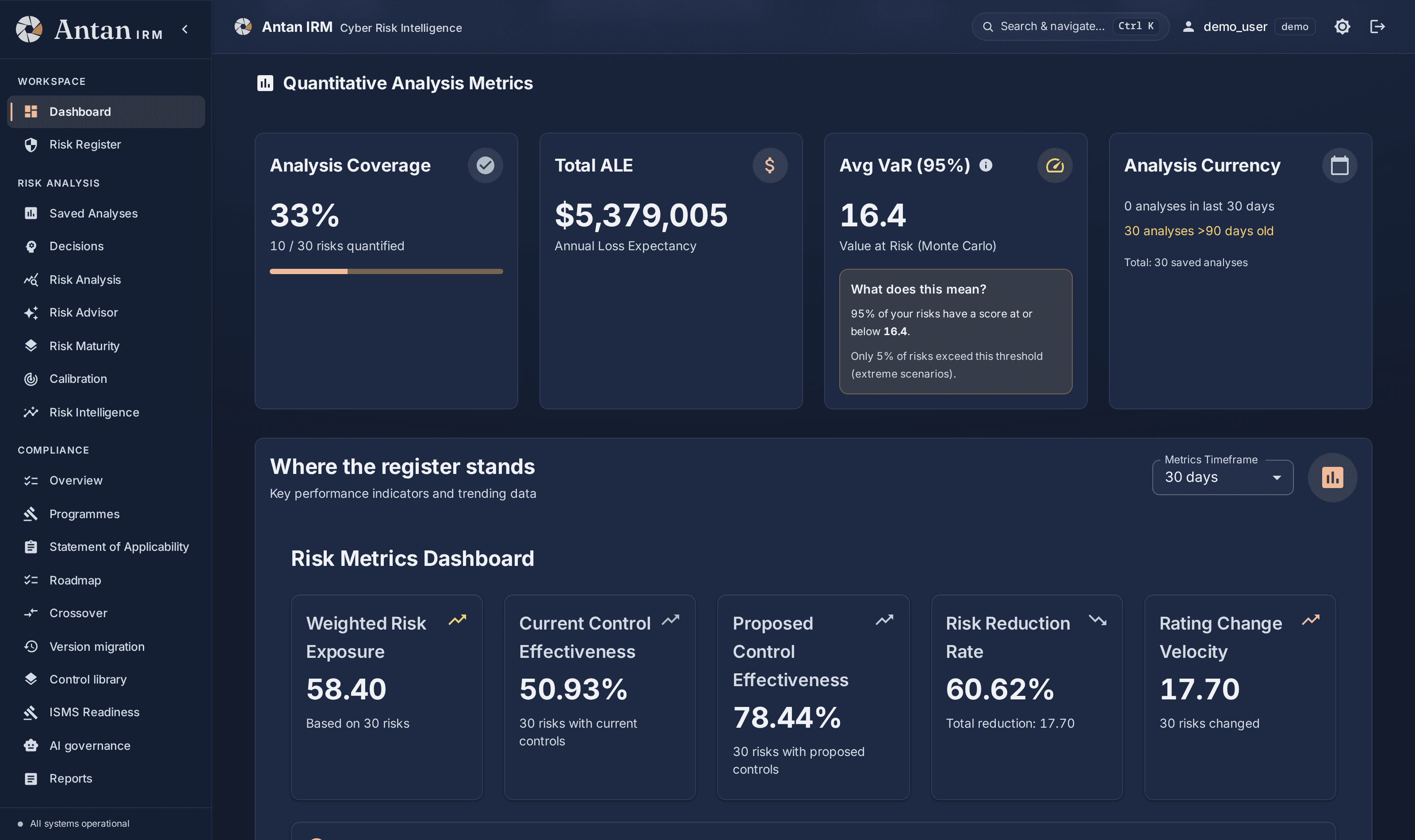
One platform, from your register to the board pack
Your own risk register, third-party and product risk, decision analysis, and compliance, brought into one place. A closer look at what the application does.
AI & knowledge
A conversational assistant grounded in your own risks, assessments, and documents, not the open internet.
- Conversational AI grounded in your risk data, with source citations
- RAG knowledge base over your own documents
- Specialist agents (threat intel, cybersecurity, compliance audit, incident response, cost-benefit, implementation planning) that show their reasoning
- Multi-provider LLMs (local Ollama, OpenAI, Google, Azure, Groq) with automatic fallback
- Built-in AI cost tracking and a spend ceiling
Quantitative risk analysis
Risk expressed in money and probability, not a colour on a heat map.
- Monte Carlo simulation
- FAIR-CAM loss modelling: annual loss expectancy and loss-exceedance curves
- Sensitivity analysis to find the factors that move the needle
- Portfolio-level risk aggregation and optimisation
Decision analysis
Compare and justify treatment options on evidence, not instinct.
- Multi-criteria decision analysis (MCDA), including AHP and value functions
- Cost-benefit and control-effectiveness modelling
- Reusable decision projects to compare and defend options
Third-party & product risk
Vendor and product risk managed alongside your own register, in one place.
- Vendor and product registers with tiered risk ratings
- Standardised questionnaires: IRQ, SIG Lite/Core, CAIQ, NIST CSF 2.0, ISO 27001:2022, SOC 2 Type I & II, NZISM
- AI-scored responses with automatic gap detection
- OSINT research: open-source, CVE/KEV, end-of-life, exploit, and dark-web intelligence
- Product CVE-exposure analytics across the fleet
Automation & monitoring
Scheduled work and integrations so the register keeps itself current.
- Scheduled reports and recurring vendor/product investigations
- Vulnerability-scanner integrations: Wazuh, OpenVAS/Greenbone, Trivy
- Real-time monitoring with a full observability stack
- Webhooks and an agent-to-agent (MCP) interface for the wider toolchain
Compliance
One assessment mapped to many obligations.
- Built on ISO 27005, ISO 31000, and NIST SP 800-39
- Control mappings across ISO 27001:2022, NIST CSF 2.0, SOC 2, PCI-DSS, GDPR, NIS2, DORA, CIS, and NZISM
Reporting
Board-ready output in minutes, not a weekend of slide-building.
- Board-ready reports with charts and narrative
- Versioned report library with scheduled delivery
- Export to PDF/Word, and publish to Confluence
Security & platform
Built to the standard I would expect of any system holding this data.
- Role-based access control across five roles
- Multi-factor authentication, passkeys (WebAuthn), and SSO
- Full audit logging and multi-tenant isolation
A secure agentic framework - AI that guards the AI
Antan IRM runs a team of specialist AI agents and a dedicated Security Agent, “Tony Synt”, that polices the others. Before any model runs, every request passes through a deterministic security interceptor: a pure-code gate that screens for prompt-injection and jailbreak attempts and routes attacks to a dead end. The Security Agent then watches the agent network from a tamper-evident audit trail, reports anomalies, maps findings to ISO 27001, NIST CSF, and NIST SP 800-53, and can pause or resume the fleet under strict admin control.
A deterministic guardrail, not a chatbot
Injection and jailbreak screening is pure code, run before any model. You cannot talk a regex out of blocking, so the usual route, jailbreaking the guard's own model, does not exist.
Separation of duties
The Security Agent reads the audit log but can never write to it. It cannot fabricate a clean record or suppress what it observed; the trail is owned by the interceptor alone.
Fails closed
A detected attack is blocked before any model executes. No specialist agent, no LLM, and no tool runs on a flagged request.
Privileged actions are gated
Pausing or resuming the agent fleet requires super-admin, is rate-limited, and is logged at critical severity before it runs.
Nothing is truly unhackable, and I will not claim otherwise. But because these protections live in deterministic, run-first, fail-closed code rather than an LLM you can argue with, the design is jailbreak-resistant and tamper-evident by construction. That is the active application security I have pioneered in the tool.
The AI cannot invent an answer it was never offered
Most tools ask a language model to write its answer as text, then read that text back. When the text comes out malformed, or carries a value nobody planned for, the tool falls back to a default, and that default is stored in the same field, in the same format, as a real answer. Nothing downstream can tell them apart.
Antan IRM does not do that. Where the question has a fixed set of valid answers, a category, a rating, a yes or no, the permitted values are declared as part of the question and the model is scored across those values alone. There is no text to parse, so there is nothing to misread, and no fallback to write. This is the pattern often called a System One model, after the fast, reflexive half of Kahneman’s thinking, and the one that drew wide attention in 2026 through TypeSafe’s Jev. Antan IRM is not built on Jev and sends it nothing: the same architecture runs here against open models, on infrastructure you control.
An answer outside the list cannot happen
The model never writes the answer as text, so there is nothing to misread. It scores the values that judgement permits and nothing else. A value I did not enumerate has no way to be returned, so there is no recovery path, and no recovery path means nowhere for a guess to come from.
The whole distribution, not a verdict
Each judgement comes back scored across every permitted value. A near-tie between high and critical looks like a near-tie, instead of being flattened into one confident-sounding label.
It refuses rather than guesses
If the model answers something other than what it was asked, the judgement is withheld and the caller is told. The previous value stands and nothing is written. A failure to decide is never recorded as a decision.
It runs on your own hardware
The mechanism works against a model inside your own network, in milliseconds. Contract text, risk descriptions and evidence do not have to leave it for a judgement to be reached.
This makes a wrong answer impossible to disguise. It does not make every answer right, and I will not claim otherwise. The model can still reach a judgement you disagree with; the difference is that it will be one of your own permitted values, with the scores it gave every alternative sitting beside it, rather than a default that appeared because something failed quietly. Each use is measured against examples where the correct answer is already known before it ships, and where a rating has not earned that confidence yet, the tool says it is being withheld rather than printing a number that looks authoritative.
How Antan IRM reasons about risk
The same quantitative methods I use in advisory engagements, made tangible.
FAIR loss quantification
Factor Analysis of Information Risk decomposes a scenario into loss event frequency and loss magnitude, turning a vague worry into a defensible number.
Monte Carlo simulation
Thousands of simulated years produce a distribution of outcomes, not a single point estimate, so you can reason about the tail, not just the average.
Scenario modelling
Model the scenarios that actually threaten your organisation, then test how proposed controls move the expected loss before you spend a dollar.
Heat maps don't survive a board meeting
A red square on a risk register tells a director nothing actionable. How much should we spend to make it amber? What is the expected loss if we do nothing? Which of three investments reduces exposure the most per dollar? Qualitative risk cannot answer these questions. Quantitative risk can.
Expressing risk in dollars and probabilities reframes the conversation from fear to finance. It lets you defend a security budget the way every other part of the business defends theirs: with numbers, ranges, and a clear line from spend to reduced loss. That is the conversation Antan IRM is built to start, and the one I help organisations have for real.
Want to know more about Antan IRM?
Try the demo, then get in touch. If you would like to know more about how Antan IRM works, or whether it could fit your organisation, I would be glad to hear from you.